Wooden Entrance Doors vs Modern Alternatives: Which Is Best for Your Home?
Most homeowners obsess over paint colours and agonise over kitchen worktops. Then they buy a front door in ten minutes flat — and wonder years later why it warps, sticks, or costs a fortune to maintain.
Your entrance door faces British weather every day. Frost in January. Summer heat that dries the wood out. That relentless November drizzle that finds every crack. The wrong material means dealing with the consequences for the next twenty years.
Wooden entrance doors have earned their place in British homes over generations. But composite, uPVC, and aluminium have all closed the gap — and in some areas, they have overtaken timber entirely. Here is what you actually need to know before you decide.
Benefits of Wooden Entrance Doors
- Traditional Appearance
Stand outside any well-kept Victorian terrace and the timber front door is usually what makes it. Solid oak or hardwood carries a weight and presence that no moulded surface fully replicates. On a period property, it simply belongs — no extras needed.
- Natural Character
Every wooden door is different. The grain direction, the knot placement, the way colour shifts from plank to plank — none of that comes from a factory. If you want a door with its own identity rather than a pressed finish, timber remains in a category of its own.
- Customisation Options
Unusual opening? Specific ironwork? A fanlight shape that no composite range will ever stock? Timber can be shaped, carved, and finished in ways the alternatives simply cannot follow. For bespoke projects or heritage properties, it is often the only material that delivers exactly what is needed.
Drawbacks of Wooden Entrance Doors
- Regular Maintenance
This is the one that catches people out. Wood needs repainting, restaining, or resealing roughly every one to three years. Skip it for a few seasons and you will find peeling paint, damp grain, and a door that swells in its frame. It is not a disaster — but it is a chore that genuinely never ends.
- Weather-Related Issues
British weather has no sympathy for untreated timber. Frost gets into fine cracks. Summer dries out the wood and causes movement. A door that closes perfectly in September can stick hard by January. This expansion and contraction, year after year, takes a cumulative toll on both the door and the frame.
- Long-Term Costs
Timber looks reasonably priced in the showroom. Factor in professional repainting every few years, occasional repairs, and eventual replacement — and it becomes the most expensive option of the four over a 15 to 20-year period. The purchase price is only the beginning.
Composite Doors — The Modern Alternative
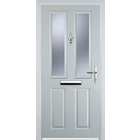
Ask an experienced door fitter what they would put on their own home and most will say composite. A solid timber subframe, GRP outer skins, and an insulating foam core — the surface is moulded and textured to replicate painted wood. From a normal viewing distance, on a well-made door, you genuinely cannot tell the difference.
The key advantages:
• Virtually no maintenance — an occasional wipe is all it needs
• Better thermal insulation than solid timber
• Will not warp, crack, or absorb moisture in any season
• Multi-point locking comes as standard across most ranges
• Wide choice of styles, colours, and glass options to suit any property
Composites have fixed timber’s main problem without giving up much of what made it appealing. You get the look. You get the solidity. You do not get the annual maintenance bill. Take a look at the full range of composite entrance doors — there are styles to suit everything from a traditional cottage to a contemporary new build.
uPVC Doors — Affordable and Practical
uPVC has an unfair reputation in some circles — largely because it ended up on Victorian terraces where it never belonged in the 1990s. Used on the right property, it is a genuinely strong choice.
The main advantages:
• The most affordable option to buy and to run — no hidden maintenance costs
• Meets modern building regulation energy requirements comfortably
• Zero maintenance — no painting, no sealing, no seasonal attention
• Fully resistant to damp, rot, and corrosion in any British weather
• Modern colour finishes and woodgrain foils are far better than they used to be
Where timber demands regular time and money to stay presentable, uPVC simply does not. Wipe it over and it looks the same as the day it was fitted. The honest limitation is aesthetic — it works well on contemporary homes and new builds but can look out of place on a period property. The full uPVC front doors range covers considerably more variety than most people expect.
Aluminium Doors — Strong and Contemporary
- Modern Aesthetics
Aluminium profiles can be made significantly slimmer than timber or uPVC, which means large glass panels and very narrow frames. The result is clean, minimal, and genuinely striking. Powder-coated finishes are available in almost any RAL colour — so customisation is broad, just in a very different direction from timber.
- Durability and Security
Aluminium does not rust. It does not warp. It does not react to moisture in any meaningful way. In terms of long-term structural integrity, it is the most reliable material of the four. Modern aluminium entrance doors are built with multi-point locking systems that take security seriously.
- How It Compares to Wood
Against timber, aluminium wins on nearly every practical measure — longevity, weather resistance, maintenance, security. The area it cannot match is warmth of character. Aluminium reads as architectural and contemporary. If your home calls for that, it is an excellent door. If it needs softness and period texture, composite or timber will serve you better. Browse the complete aluminium doors range for full specifications before deciding.
Wooden vs Composite vs uPVC vs Aluminium Doors
A quick side-by-side across the five areas that tend to matter most:
| Feature |
Wood |
Composite |
uPVC |
Aluminium |
| Maintenance |
High |
Very Low |
Very Low |
Very Low |
| Security |
Good |
Excellent |
Good |
Excellent |
| Durability |
Moderate |
High |
High |
Very High |
| Energy Efficiency |
Moderate |
Excellent |
Very Good |
Good |
| Long-Term Cost |
High |
Medium |
Low |
Medium–High |
Which Door Is Right for Your Home?
There is no single correct answer. It comes down to three things: what your home looks like, how much time you are genuinely prepared to spend on upkeep, and what your budget realistically covers over the long term.
A practical guide:
• Period property with strong aesthetic priorities, happy to maintain it — timber may still be the right call
• Want the timber look but cannot commit to regular upkeep — composite is the sensible move
• New build or contemporary home, clear budget — uPVC delivers excellent value without drama
• Architect-designed property where design is the priority — aluminium is worth the investment
At UK Trade Windows and Doors, the starting point is always the same: be honest about how you actually live, not how you intend to live. The door that suits your real habits and your real home will serve you far better than the one that looks best in the catalogue.
Conclusion
Wooden entrance doors are not going anywhere. For the right property and the right homeowner, solid timber still has real character, real craftsmanship, and a presence that is difficult to replicate.
But composite, uPVC, and aluminium doors have earned their place. Composites now match the traditional look while outperforming wood on every practical measure. uPVC continues to offer the best value for money. Aluminium has carved out a strong position at the contemporary end of the market.
Whichever direction you are leaning, take a few minutes more than most people do. Explore the composite doors, uPVC front doors, and aluminium entrance doors ranges properly and compare them side by side. The right door is out there — it just deserves more than ten minutes of your time.
This article does not belong to any category.